
Michael’s story

I remember a client, Michael, who scheduled an appointment with me after attending one of my lectures. Our first meeting seemed to go well, and he appeared glad and motivated to begin his taper. But after that, I didn’t hear from him again. I wondered if my approach hadn’t resonated with him after all, or if something I’d said had confused or discouraged him.
Then, a year and a half later, I got a phone call. The caller simply wanted to share that he had successfully tapered off the antidepressant duloxetine, just as we had discussed the previous spring. It was Michael! The exact opposite of what my initial, doubtful, and ever-negative thoughts had led me to believe turned out to be true. Curious, I gently asked if he’d be willing to share his withdrawal journey. He was happy to help and wrote the following to me:
[NB: This is not medical advice or guidance to follow]
In 2015, three months after my son was born, I entered a depression. It was my second depression. The first one was seven years earlier and had been treated with medication, so I decided to try that again, this time with duloxetine at 90 mg. About a year into the treatment, I started feeling better and noticed an improvement in my depression.
After I had been stable for some time, I worked with my psychiatrist to reduce the dose to 60 mg and then to 30 mg, which is the lowest dose. Up to this point, my taper went smoothly with no major fluctuations in my mood. I asked my psychiatrist what to do next, now that I was on the lowest dose.
The message was that, medically speaking, I had been declared healthy and therefore no longer needed to have my prescription renewed. I was referred back to my general practitioner – and the medication? That I could just stop taking, now that I was on the lowest available dose.
Only I couldn't. Each time I tried, I got these electric shock sensations through my brain and numbness in my face, as well as anxiety and tension permeating my body. I had difficulty concentrating and found myself unusually irritable, even toward my family, who had done nothing wrong. It was completely out of character for me. After several failed attempts, I gave up and simply renewed my prescription with my GP.
I continued taking the medication, managed my job, and felt healthy. I just wanted so badly to come off the last 30 mg, but didn’t know how.
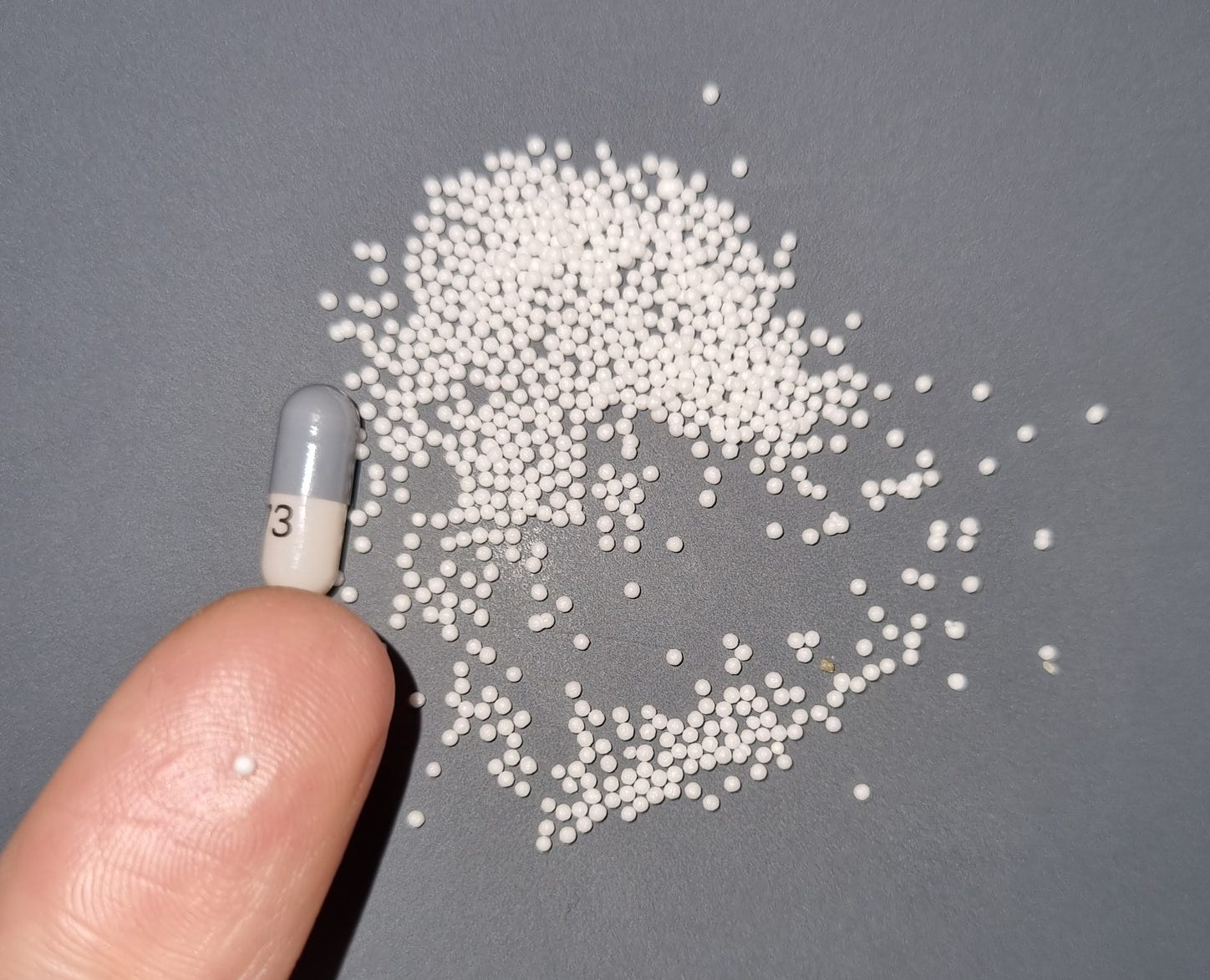
A few years later, I attended a public lecture on psychiatric drug withdrawal and learned that I could taper off more gradually by opening the capsule, counting the many tiny beads inside, and then removing about 5%–10% of these at a time. Armed with renewed courage and optimism – and finally understanding why my previous attempts had failed, namely that I’d stopped at too high a dose – I decided to try one more time. I reached out to the presenter, Anders, and together we devised a plan for my taper: Every two to three weeks, I would remove about 5%–10% of the hundreds of tiny beads inside each capsule, adjusting the reductions and the pace based on how I felt. I began by removing 10% of the beads. After about three reductions, withdrawal symptoms started to show. I continued with approximately 5% reductions and then I was fine again.
The key was to make each dose reduction progressively smaller and smaller as I approached 0 mg, calculating the percentages based on the current dose, not the original dose. Practically, this meant eventually removing only one or two beads at a time.
Tapering with the beads made a world of difference to me compared to when I had stopped abruptly at 30 mg, which had previously led me into severe withdrawal. Gone were the severe and disabling symptoms; most of my taper brought only mild, and at times moderate, discomfort. Aside from one instance when work was a bit stressful, I noticed no negative changes. During that stressful period, I simply held the dose until the stress lessened, then continued tapering.
It's also worth mentioning that throughout the taper, I worked out regularly at the gym, as I noticed right away how good it made me feel. If anything, I had a lot of respect for the withdrawals and didn't want any relapses. So, I kept going. Now I am medication-free, and I feel great – in fact better than before. I continue to exercise and call it my new medicine.
I can feel a heightened emotional sensitivity that has now become like a close friend to me. I feel slightly more vulnerable, and sometimes old thought patterns that I remember from my younger years resurface. But now, I recognize my sensitivity and embrace it, allowing it to be part of me again. I now feel ready to handle my sensitivity rather than rejecting and dismissing it as something I want to rid myself of. It's actually very beautiful to me, how this journey has come full circle, and I now feel in a position to manage my life without medication.
Sometimes, tapering is no more complicated than slowing down – far, far down. Michael's story is an example of how far the right information can sometimes take us. However, rigid rules like ‘reduce X mg every Y weeks’ often don’t hold up in practice. How much to reduce the dose depends on what the current dose is, which naturally changes during a taper. While the 5%–10% reductions (of the current dose, not the starting dose) seem to be where most people can minimize withdrawal symptoms from most psychiatric drugs to a manageable level – and sometimes even prevent them – such small reductions are rarely necessary all the way from start to finish. To understand how this works, see my Hyperbolic Tapering 101 post or the lecture above.
NB: Tapering psychiatric medication is a highly individual process. This example should not be taken as direct guidance to follow and replicate. For Michael, withdrawal symptoms emerged when he went below 30 mg, whereas for others, symptoms may occur already at 60 mg or even higher. Moreover, once withdrawal showed, Michael managed reducing by 5%–10%, but for others, even this rate will be too rapid and cause severe withdrawal, requiring even smaller dose reductions. And duloxetine in particular is known to sometimes take many years to fully taper off.
And one last time: This is not medical advice or guidance to follow.