
The antidepressant taper trap
and a little bit about how to break it

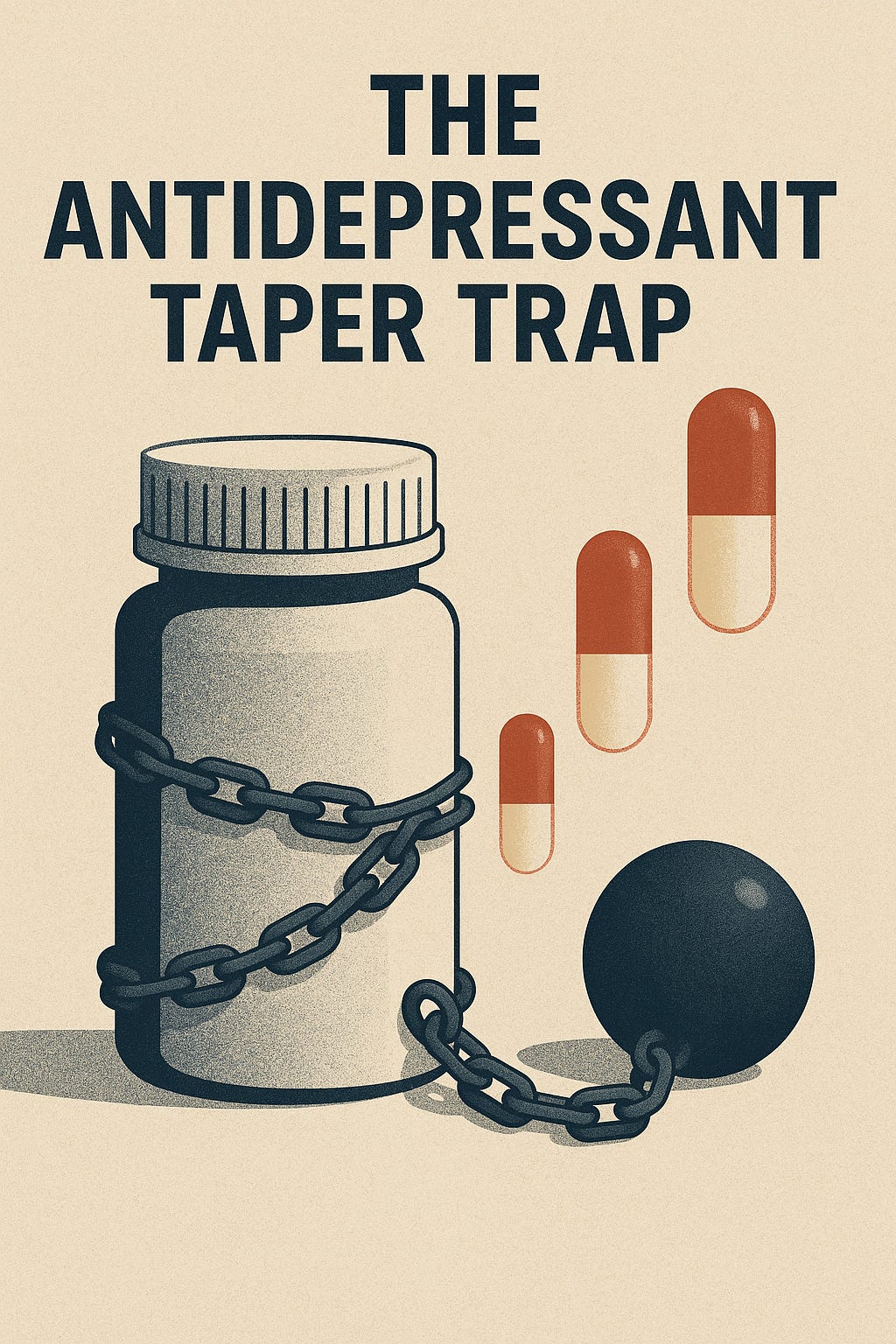
Although people are different and unique, I can almost predict how most of the messages I receive as a psychologist begin:
A crisis. A prescription. And then, after a few years, a wish to come off the antidepressant or other psychiatric drug that more than one in five adults take in most Western countries today.
Many tell me they’re feeling better. The crisis has passed. They’ve done years of therapy, worked on themselves, and now feel ready to stand on their own two feet – or they’re simply wondering what the medication is actually doing to them.
For others, the story is different: they’ve grown worse since starting the medication and have come to suspect that what was meant to help has, in some way, hurt and become part of the problem.
Whether they’ve improved or deteriorated, the next step is often the same.
So they go to their doctor, who assures them that coming off is no big deal: “Cut the dose in half, wait a couple of weeks, cut it in half again – then you can stop.” Or: “Taper the dose to zero over 6–12 weeks.”
That’s what the official medical guidelines recommend.
Here are a few examples from the emails I’ve received from people who followed that advice:
– A woman who, within weeks, went from functioning well at work to lying in bed, trembling, anxious, and unable to even care for her children.
– A young man who suddenly began vomiting from nausea and developed panic attacks and obsessive thoughts he had never experienced before.
– A student who, in despair, ended up in the emergency room with suicidal thoughts, heavy uncontrollable ruminations, and a depression-like mood – after following his doctor’s tapering plan to the letter.
– A man who woke up days after stopping his medication with extreme shaking, vivid nightmares, and sensations of electric shocks (brain zaps) coursing through his body.
– A mother of two who felt such intense inner restlessness that she couldn’t sit still, let alone gather her thoughts or focus on anything. She wrote that it felt like “having constant panic inside my body – without any external cause.”
All five believed they had relapsed. So did their doctors. And that’s where the real problems begin.
The patient is told that “the illness has returned,” and the solution is therefore to resume treatment. And that’s how many end up in long-term medication cycles they never wanted or intended. The tapering that was supposed to mark a new chapter becomes a repetition of the old one. After several failed attempts, they start telling themselves: “Maybe I’m just one of those people who needs medication for life.”
But there’s another possibility: that the worsening is caused by withdrawal symptoms – the body’s reaction to the dose being reduced too quickly, or worse, stopped abruptly or from too high a dose.
Antidepressants do, of course, work by dulling emotional life and putting a lid on how we’re feeling. That can be a help and a relief when we’re in deep crisis or not yet ready to face what lies beneath. It’s therefore not surprising that some of what the medication has suppressed begins to stir again when the lid is lifted.
At the same time, these drugs, all psychiatric drugs, can cause withdrawal symptoms that – and this is the whole problem – can mimic the original symptoms for which the drugs were prescribed. You’ll find the full list of symptoms here.
In addition to sweating, dizziness, flu-like sensations, brain zaps, extreme sensitivity to sound and light, and burning or trembling sensations in the body, withdrawal can also manifest as anxiety, agitation, insomnia, racing thoughts, excessive rumination, mood swings, irritability, poor concentration, and fatigue.
So how do you know what’s what?
How do you know whether the medication is working – or merely suppressing the withdrawal state it itself created?
That answer can only be found at the end of a properly paced, gradual tapering process. One that gives the body time to adapt and prevents it from “fighting back” with symptoms against its host.

With medication comes doubt: What is me, and what is the drug?
When coming off medication, a new doubt arises: What is me, and what is withdrawal?
In reality, there are three distinct states: You can be on medication, off medication, or on your way off – a transitional phase where the body is readjusting its receptors.
Paradoxically, it is not uncommon for withdrawals to become the hardest of all three (depending, of course, on how fast or slow you taper). A new crisis in itself – not only because the symptoms can be so intense, pervasive, and confusing to navigate, but also because help is so limited. Many encounter disbelief, ignorance, or even resistance from their doctor when they describe what they’re going through.
To understand that skepticism, we have to look at the clinical guidelines doctors rely on. These describe withdrawal symptoms as “usually mild and self-limiting,” “transient,” “harmless,” “brief,” “typically lasting a few days to weeks,” and only severe in “a minority of cases.” Most list only four to 15 possible symptoms – while research has documented more than 75 different withdrawal symptoms from antidepressants.
Compared with patients’ experiences, these are staggering understatements.
So, who is right, the guidelines or the patients?
The answer is: both – as long as you understand that the guideline descriptions only apply to those who took the medication for the 6–12 weeks that the clinical trials behind them lasted. These guidelines were written before we knew about the long-term effects of antidepressants, including withdrawal after prolonged use.
That’s often how it goes. It’s important to understand that even when a drug is approved for the market, research continues – and knowledge about its long-term effects usually comes only later.
Today, we know more. The average patient on antidepressants doesn’t take them for 6–12 weeks, but for five years. Now, withdrawal occurs because the body adapts to the drug – and the longer it has had to adapt, the harder it is to readjust. Duration of use is therefore one of the main predictors of whether withdrawal will occur, and how severe it will be.
Newer research paints a very different picture: withdrawal is far more common, often severe, and can last for months or even years. Yet those studies are still not reflected in most official guidelines.
This means patients often face a crossroads: Either a doctor who is up to date on the latest evidence and can help them taper safely – or one who still relies on outdated papers.
And this is not something I’m making up.
In March 2025, the World Health Organization wrote in its guidance to member states:
“Withdrawal symptoms from psychotropic drugs can be more severe than previously thought and may be mistaken for relapse.”
And in October 2023, both the WHO and the UN stated that member countries should “adopt a higher standard for the free and informed consent to psychotropic drugs given their potential risks of harm in the short and long term.”
Thus, there is full agreement between research, patient experience, and international recommendations. Yet clinical practice still lags behind, creating confusion for patients and often resulting in unnecessary long-term medication.
That’s unfortunate, because withdrawal says nothing about a person’s ability to manage their life and inner world without medication. It only says that the body is trying to regain balance at its own pace – and that it was simply given too much to handle at once.
The good news is that this can be prevented.
Withdrawal symptoms can in far most cases be avoided or significantly reduced to a tolerable level by tapering much more slowly. A gradual taper – often over years, decreasing by 3–10% of the current dose at a time and making reductions progressively smaller throughout, known as hyperbolic tapering – is like night and day compared to the rapid tapers still recommended in official guidelines.
And that’s how the story ends for many of those who write to me: The pattern breaks when they start approaching their symptoms as withdrawal, not relapse, and taper slower.
What I’ve learned, again and again, is to look at withdrawal not as a failure, but as feedback. When we listen to that message and understand what it’s calling for, we can stop mistaking withdrawal for relapse, and people finally get to move forward instead of going in circles.
If you’d like to support this work
… there are three main ways:
1) Share, like, or comment on the articles you like.
2) Upgrade to a paid subscription and join the chat room + monthly live Q&As on Zoom.
3) Leave a positive review on my book’s Amazon page.
If you’ve found something valuable here - a perspective that helped you, a sentence that resonated, or a truth that needed saying - please consider upgrading to a paid subscription or sharing this post in your network. Every dime goes straight back into creating top-tier, meaningful content for all of you out there.
Thank you so much Anders - I'm tapering right now - slowly, as I have read a lot of your work and learned a lot from you. My doctor, however, thinks that my tapering is far too long. But I insist on doing it slowly. My life now is too important to gamble with quick tapering.
You are a light in the darkness. I keep reading your work, I keep pushing each day, I tell about your work to anyone it might be relevant for. Thank you for being a light and a star.
Love your channel. Thank you for finally addressing this terrible epidemic. ❤️