
The Medicated Client - 3-Day Professional Training (April 2026, online)
Registration is open

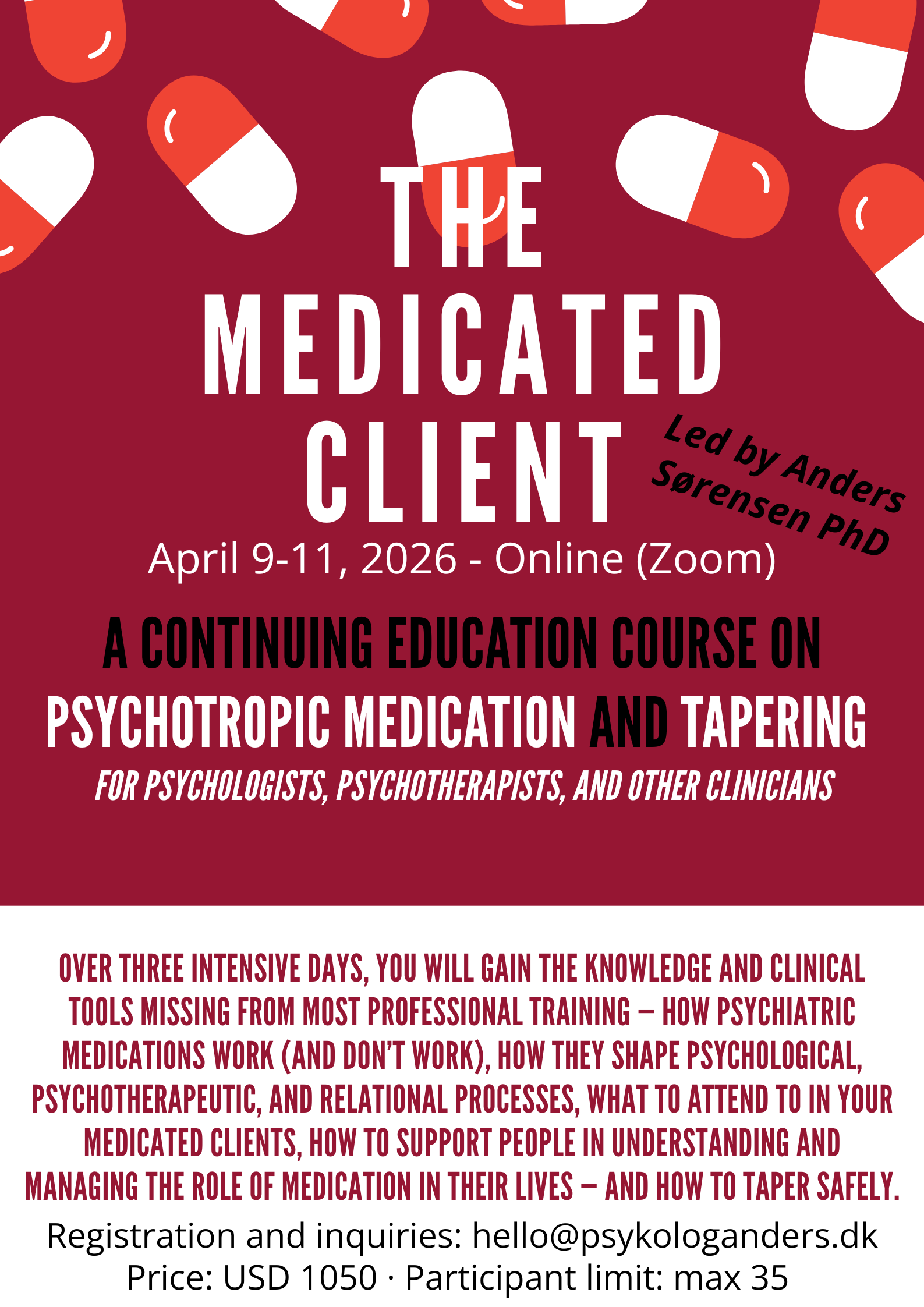
April 9–11, 2026. Online via Zoom.
For psychologists, psychotherapists, body therapists, and other therapists.
Led by Anders Sørensen, clinical psychologist and PhD in psychiatry
Registration: hello@psykologanders.dk
Overview
Many mental health professionals today work with medicated clients.
And yet, knowledge about psychotropic medication remains largely confined to physicians and psychiatrists – even though these drugs directly affect the very emotions, cognitions, relationships, and bodily signals we work with in psychotherapy and body-based therapies.
The result is a professional paradox: We are asked to help people while they are under the influence of medications we were never trained to understand or navigate – often mistaking drug effects, side effects, or withdrawal for psychological problems.
This course was developed to change that.
We’ll cover:
- Antidepressants (SSRIs, SNRIs, TCAs, atypicals)
- Antipsychotics (all generations)
- Benzodiazepines
- Mood stabilizers
- ADHD medications (stimulants)
All of these drug classes can also be difficult to come off. When tapered too quickly – including when following standard clinical guidelines – withdrawal reactions can easily be mistaken for relapse, leading to premature reinstatement and unnecessary long-term medication. Safe tapering principles and clinical guidance will be a key part of the course.
No pre-recorded modules. All live. Together. On Zoom. With plenty of time for your questions and case discussions.
What the course offers
Over three intensive days, you will gain the knowledge and clinical tools you never received in your professional training, including:
• how psychiatric medications work (and don’t work)
• what happens in the brain and body during medication use, and tapering and withdrawal
• how medication shapes psychological, emotional, psychotherapeutic, and relational processes
• how medication fits into modern psychotherapeutic frameworks – and how the two can, and sometimes cannot, work together
• what to attend to when working with medicated clients, including full side effect profiles, emotional blunting, physiological effects, and cognitive effects
• how to support people in understanding and managing the role of medication in their lives
• how to work and collaborate constructively with the prescriber
• how to safely stop medication using hyperbolic tapering, recognize withdrawal symptoms, distinguish them from relapse, and support clients through the process.
Key themes
• How medication and psychotherapy interact
• How medication affects your client’s energy, initiative, emotional range, cognitive capacity, sleep, attention, motivation, and relational presence – in therapy and in everyday life
• What to look for during medication initiation, switching, tapering, and discontinuation
• How to talk about medication with clients across different phases of treatment
• How to respond clinically when a client deteriorates after a dose change or a new prescription – without crossing professional boundaries
• How to understand and use psychiatric medication from a drug-centered approach
• What to do when medication effects obstruct the therapeutic or relational process
• How to distinguish withdrawal from relapse
• How to support clients emotionally when coming off medication
• Understanding and applying the principles of hyperbolic tapering, including dose reductions, stabilization phases, pace, withdrawal management, and how and when to adjust the pace.
• How to apply psychotherapeutic methods and principles to support people through withdrawal
• How to collaborate constructively with prescribing physicians
• How to help clients regain initiative, emotion, and direction when the medication pulls in another direction
• Emotion regulation – with and without medication
• How to support the nervous system during tapering (sleep, stress, nutrition, metabolic stability)
• Understanding the research on efficacy, placebo effects, adverse effects, and long-term outcomes of psychiatric medication
• How to work from trauma-informed and transdiagnostic perspectives, viewing symptoms as meaningful responses rather than signs of disease.
• How to help clients differentiate between “me” and “the medication.”
Why this course?
Because medication is now part of everyday clinical reality – whether we like it or not.
Because psychiatric drugs affect precisely what we work with in psychotherapy:
emotion, thought, motivation, attention, the body, and relational presence.
And because, despite their widespread use, much of the latest research on long-term effects, side effects, and withdrawal effects has not yet reached everyday clinical practice.
This course demystifies psychopharmacology and brings awareness and evidence into the therapy room, giving clinicians a shared, accessible language, clearer clinical judgment, and concrete therapeutic skills to support people through tapering and withdrawal.
What you will leave with
After three days, you will leave with:
a level of psychopharmacological understanding rare among non-prescribing clinicians – and the ability to apply it meaningfully in psychotherapy
clearer clinical judgment when medication, side effects, or withdrawal shape a client’s presentation
a confident, evidence-based, and ethically grounded way of talking about medication, diagnoses, and tapering with clients and colleagues
practical frameworks for working with medicated clients without psychologizing drug effects or missing withdrawal
a solid understanding of medication as a strategy - rather than a disease-correcting intervention.
Practical information
Dates: April 9-11, 2026
Times: 7.00-13.00 PT / 8.00-14.00 MT / 10.00-16.00 ET / 15.00-21.00 GMT / 16.00-22.00 CET)
Format: Live online (Zoom), with a mix of lecture, guided exercises, case work, discussion, and group reflection.
Price: USD 1,050
Participants: Limited to 35 to ensure depth, dialogue, and space for your cases and questions.
Registration and inquiries: hello@psykologanders.dk
Participants receive a certificate of completion.
A closed peer group and optional individual supervision are available after the course.
This course is a professional continuing education offering and is not formally accredited for CE/CME credits.
No prior knowledge of psychopharmacology is required.
I would love to do this course but I’m in Australia Melbourne and the time is 2 am till 8 am which I wouldn’t be able to do!
Is there a chance of recording?
Anders... This is amazing! I am going to forward this to several providers who are interested. Thank you for offering this continuing education course.