
The Second Layer of Withdrawal
Withdrawal vs. Withdrawal + Resistance

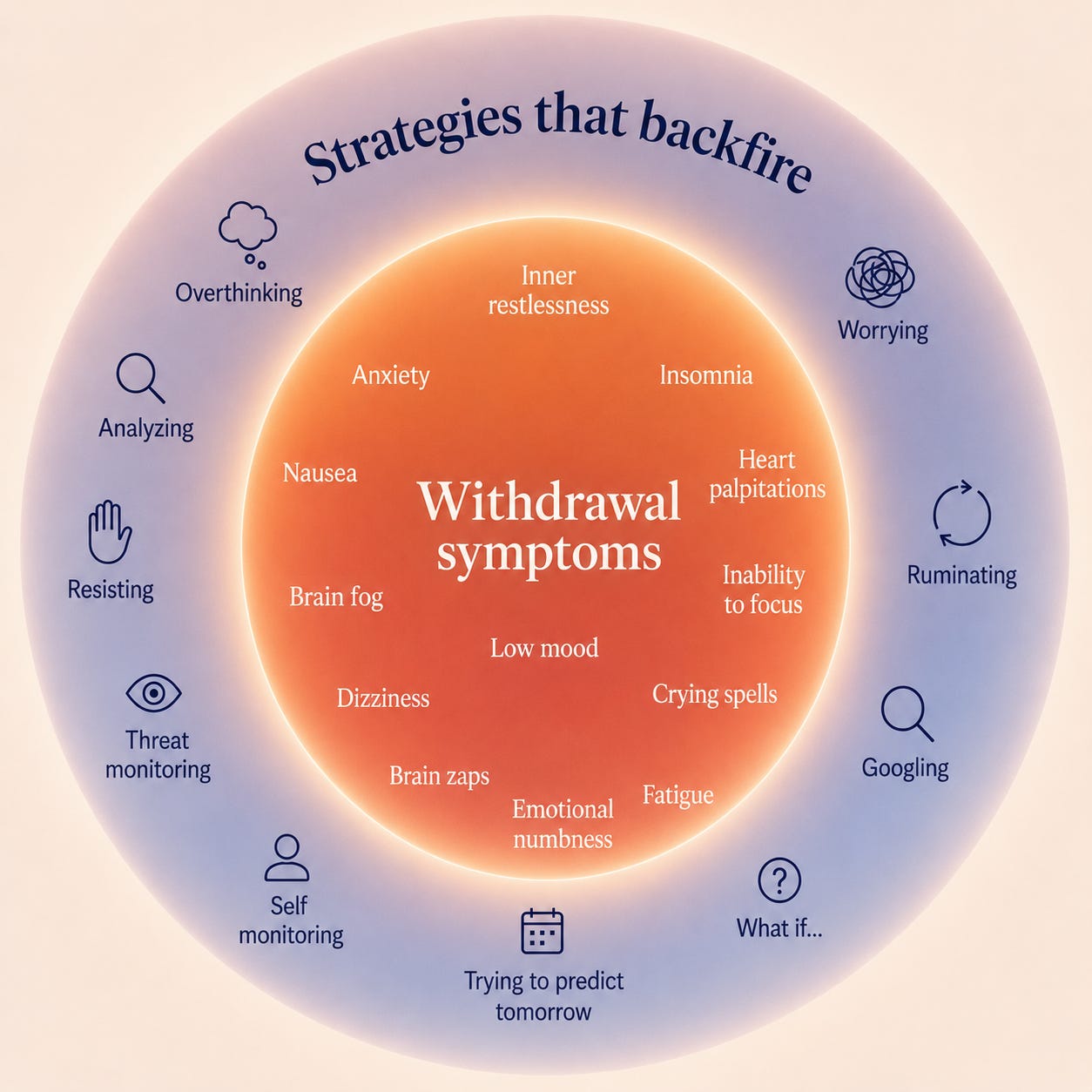
When you’re in withdrawal, there are often two things happening at the same time.
The first is withdrawal itself:
The inner restlessness, insomnia, nausea, inability to focus.
The heart palpitations, waves of terror and anxiety, dizziness, brain zaps.
The low mood, crying spells, emotional numbness, fatigue.
The strange sensations that make you wonder whether you’re losing your mind.
Those symptoms are real.
And then there is something else. Something that often goes unnoticed because it feels so reasonable.
The constant monitoring.
The checking.
The analysing.
The resisting.
The Googling.
The endless search for patterns.
The attempts to predict tomorrow based on today.
The calculations, the planning, the ”what ifs.”
And before long, you may find yourself carrying both:
Withdrawal plus the effort to control withdrawal.
Because while we cannot choose to stop experiencing withdrawal symptoms,
we often have way more influence over our relationship with them than we realise.
Why withdrawal pulls us into control mode
The desire to understand and control withdrawal is completely understandable.
Psychiatric drug withdrawal is inherently unpredictable.
Symptoms fluctuate. Good days are followed by bad days. Some days you wake up feeling almost normal. The next day, it can feel as though you’ve gone backwards for no reason. New symptoms can emerge months into the process, and existing ones can disappear and then return.
Faced with such uncertainty, most people naturally start looking for patterns and things to do.
When the ground keeps shifting beneath our feet, the mind naturally tries to regain some sense of stability.
It starts asking questions:
What’s happening?
Why today?
Am I going crazy, or is this normal?
Will this pass?
Did I do something wrong? Was it the coffee I had yesterday? The poor sleep? Stress?
Should I change something?
Am I healing? Am I getting worse?!
Is this withdrawal or relapse?
Is this me without meds then?
The mind invites us to monitor ourselves. To constantly "check in" and compare today with yesterday. Many people know the feeling of waking up and immediately starting to assess: How do I feel? Better? Worse? What's today going to be like?
Its intentions are good: It’s trying to prepare and stay safe.
The problem is that these strategies rarely provide the certainty you are hoping for.
Instead, they often become another source of distress, even though they feel helpful in the moment.
The control agenda survives because it occasionally produces relief. Not because it solves withdrawal, but because doing something often feels better than sitting with uncertainty.
The trap
Most of the mental habits that emerge during withdrawal present themselves as solutions to the very distress they end up amplifying. When symptoms roar inside, it feels sensible to think harder and search for the missing piece that will finally explain and resolve everything. And when symptoms are unpleasant, our instinct is to turn towards them and try to fix them. To make them go away. To do something.
Here’s the thing.
The more attention goes into monitoring symptoms, the larger they appear.
The more time spent checking how you’re doing and feeling, the harder it becomes to focus on anything else, and with that, for symptoms to step into the background and self-regulate.
The more energy invested in predicting the future, the more frightening the future starts to feel.
Left unchecked, withdrawal can begin occupying not only your nervous system but your entire field of attention. And that’s exhausting on a whole other level.
I’ve seen people become trapped in a cycle where symptoms generate monitoring, monitoring increases awareness of symptoms, increased awareness makes symptoms feel more prominent, and the increased prominence generates even more monitoring.
And I've helped people out of this cycle by gradually loosening the control agenda. At first, this can feel frightening - almost like deliberately putting down a shield you've come to rely on for protection. After all, monitoring, analysing, checking, and preparing can create a sense that you're staying ahead of things.
But much of that control is an illusion.
Withdrawal remains unpredictable whether you spend six hours thinking about it or six minutes. The shield feels protective because it gives you something to do, but it rarely changes what the nervous system is actually doing. What it does change is how much of your day becomes consumed by withdrawal.
I do this by helping people understand their role in the process.
Your body's job and your job
One of the most helpful shifts people can make during withdrawal is recognising which aspects of the process belong to them and which do not.
Healing is not your job.
Healing is your body’s job.
Your nervous system is already attempting to restore equilibrium. It is adapting, recalibrating receptors, and reorganising brain chemistry in ways that occur largely outside conscious awareness.
No amount of analysis can force receptor systems to adapt faster. No amount of monitoring can accelerate neurological recovery.
Your role is different.
Your role is to create the conditions that allow healing to occur.
Part of that means tapering the dose slowly enough that symptoms remain within a tolerable range. Beyond a certain threshold of intensity, no psychological strategy will compensate for severe withdrawal. If symptoms are overwhelming, the taper itself needs adjustment according to hyperbolic principles.
But once symptoms have been reduced to a manageable level - often meaning they can step into the background, at least partly, when attention is directed elsewhere - a different challenge emerges: learning how to stop interfering with the process.
In other words, a more productive goal is learning how to live alongside symptoms.
The paradox of allowance
As sure as night is dark and day is light, people eventually discover the paradoxical effect of allowing symptoms vs. fighting them:
Symptoms given space take up less space.
Symptoms resisted tend to take up more space.
Many people initially hear this as resigning themselves to suffering and giving up control. Or that it means pretending symptoms are not real.
That’s the mind talking again.
What allowance really means is recognising that resistance tends to magnify the experience we are trying to escape.
And of course you're trying to escape it. For one thing, because it's so painful and chaotic. For another, because many people feel understandably angry about finding themselves in a situation they were never warned about.
Yet, the resistance doesn’t work.
Consider what happens when you spend several hours or an entire day checking whether a symptom is present and what it means, monitoring whether anxiety is increasing, and/or assessing whether you feel better or worse than yesterday.
The symptom becomes the centre of attention.
Then, perhaps on another day, you become absorbed in a conversation, a television programme, work, gardening, a walk, or time with friends and suddenly realise that the symptom faded from awareness for a while.
Technically, the symptom may still have been present - just as the sensation of the chair you're sitting on, the sounds around you, or the feeling inside your mouth are still present, even though you rarely pay attention to them. It simply wasn't occupying the entire room when attention was directed elsewhere. It had become background noise. And just like real background noise, the closer we listen to it, the louder it seems.
Ironically, allowing symptoms some space frequently reduces the amount of space they occupy.
Again, this does not mean symptoms are imaginary. It means attention matters. Once symptoms have been reduced to a tolerable level through proper tapering, you often gain some influence over where your attention goes, even if you don’t have much influence over the symptoms themselves.
This is very different from the mind’s control agenda. One is about choosing where to place attention. The other is about trying to eliminate, predict, or figure out symptoms. The two are often pulling in opposite directions.
Letting go of the control agenda does not mean becoming passive. It means directing energy towards the things you can influence rather than the things you can't.
Moving from prediction to navigation
Many people approach withdrawal as a prediction problem. They want to know what tomorrow will look like and what today will bring. To understand every fluctuation, weird thought and sensation. They want certainty in something that is inherently uncertain.
One reason we spend so much time trying to predict withdrawal is when we don’t trust ourselves to handle a bad day.
If tomorrow becomes terrible, what will I do?
If symptoms return, what then?
If a wave hits, how will I cope?
How am I supposed to plan a life around something this unpredictable?
These questions - however understandable they may be - are what keep people trapped in endless forecasting.
A more useful question is often: How do I navigate difficult days when they arrive?
This shift may seem subtle, but it can change everything.
Here’s a simple exercise. Instead of asking why today is bad (or rather, instead of answering your mind’s questions about why today is bad), try asking what helps when today is bad.
Instead of trying to eliminate uncertainty, we develop confidence in our ability to respond to it. Instead of trying to eliminate symptoms, we develop a roadmap of what helps when they happen. What matters is discovering your own toolkit.
Over time, most people discover practical strategies that make difficult days more manageable. They learn when to rest, when to seek support, when to do more, when to distract themselves, when to lower expectations, and when simply getting through the day is enough.
What matters is developing trust that difficult days can be navigated. And once people know how to handle bad days, they become far less preoccupied with predicting them.
This doesn’t mean you should never look for patterns.
Some patterns are real and useful. If withdrawal consistently becomes worse when you drink coffee, alcohol, take a particular supplement, doomscroll on your phone, isolate, sleep too little, or go through a period of stress, that is worth noticing and acting on.
But there is a difference between observing a clear pattern and searching endlessly for explanations. One can help you navigate withdrawal. The other often turns into a never-ending attempt to make an unpredictable process predictable.
The goal is to stop demanding certainty from every symptom fluctuation, not to stop paying attention altogether.
And you can absolutely pay attention to symptoms, reflect on them, and learn from them - as long as you're the one deciding when to engage with those questions and when to leave them unanswered, rather than being pulled around by them all day.
A wound that knows how to heal
Withdrawal is like a wound.
Imagine constantly poking at a cut to see whether it’s healing. Analysing it, comparing it to yesterday, trying to force it to close faster.
None of those actions contributes to healing. The wound already knows what to do.
Withdrawal is obviously more complex than a cut on the skin, but the principle is similar. Your nervous system already knows how to recover.
The challenge is allowing the process to unfold while continuing to engage with life as best as you can, while recovery unfolds in the background.
Of course it’s hard!
I know it’s hard.
That’s what symptoms - and catastrophic thoughts about symptoms - do:
they pull your attention towards them.
Dropping the control agenda may therefore feel like putting down that shield you’ve come to rely on. But the shield is heavier than it is protective.
If anything, the process becomes considerably lighter once we stop carrying the additional burden of trying to control every part of it.
The two versions of withdrawal
So yes, there are really two ways of being in withdrawal.
One is withdrawal itself.
The other is withdrawal plus the endless struggle to control it.
Both are understandable. Both are deeply human. Every instinct in your body will tell you to figure it out, get ahead of it, prepare for it, and gain control over it.
I’ve done the same thing in difficult periods of my own life.
Most people do.
But over the years, I’ve watched thousands of people move through withdrawal, and one pattern keeps appearing.
The people who suffer least are rarely the people who become best at predicting and controlling withdrawal.
They’re usually the people who become best at living alongside uncertainty.
The people who learn to let symptoms be present without making them the center of every day.
The people who know what to do when bad days arrive.
The people who gradually return their attention to the parts of life that withdrawal tried to take away.
The people who manage to stop spending quite so much time fighting the healing process itself.
To be clear, I don't mean "the people" as though this describes a particular type of person. I mean the people who gradually learn these skills. In my experience, these are habits that can be developed over time, not traits that some people simply have and others don't.
Spot on indeed. Thank you, To me, this concept is GOLD!
Personally, it has been a game changer to cultivate what I call “healthy skepticism” towards ALL thoughts, emotions, and body sensations that present as negative/alarming…
Just to hear/feel them, then breathe, then hold firmly and confidently to the (very likely) possibility that they are “just” withdrawal speaking.
It’s counterintuitive because it requires turning down the radar on thoughts and feelings that would usually be valuable signals worth hearing (in an unmedicated person), and deserve attention.
But coming off these drugs changes not only how we experience things, but how we interpret things, as your article so clearly describes.
Best wishes and gentle healing to all… for me, this is (at times) an extremely scary, challenging, and difficult process but also a deeply liberating and empowering process. I wish us all well.
Thank you Anders and keep up your valuable work! 🙏❣️
I found so much resonance in this article to my lived experience. I wouldn’t place my marker of when I began to grasp this paradox of releasing the reflexive noticing and wondering about the withdrawal effects as ‘early on’ in my journey or even at ‘sooner than later’, but I can attest that when it finally showed up, and it was probably the result of exhaustion to be honest of trying to predict if it would be a good day, or the start of another wave or another night sleepless added to the current consecutive three…when I didn’t have any runway left on trying to exist that way without knowing it would happen, I did in fact find myself deliberately choosing to cherish minutes. Literal minutes where perhaps I found I had lingered on the sensation of the temperature of a cup with tea on the palms of my hands, or the focus required to fill a bird feeder even with the pronounced tremors and the satisfaction that brought in choosing to do so regardless of anticipating it would be difficult or wasteful with a lot of seed missing the container; things like this, quite small things—I came to name these moments that I managed to exist ‘alongside the withdrawal’ as so eloquently described here by Dr. Sorensøn. When I managed a few in a day, the accrual of them, I’d call that ‘winning the day’.