
When life changes, but the strategy doesn’t – what to do?
+ Two psychological exercises for "updating" a nervous system

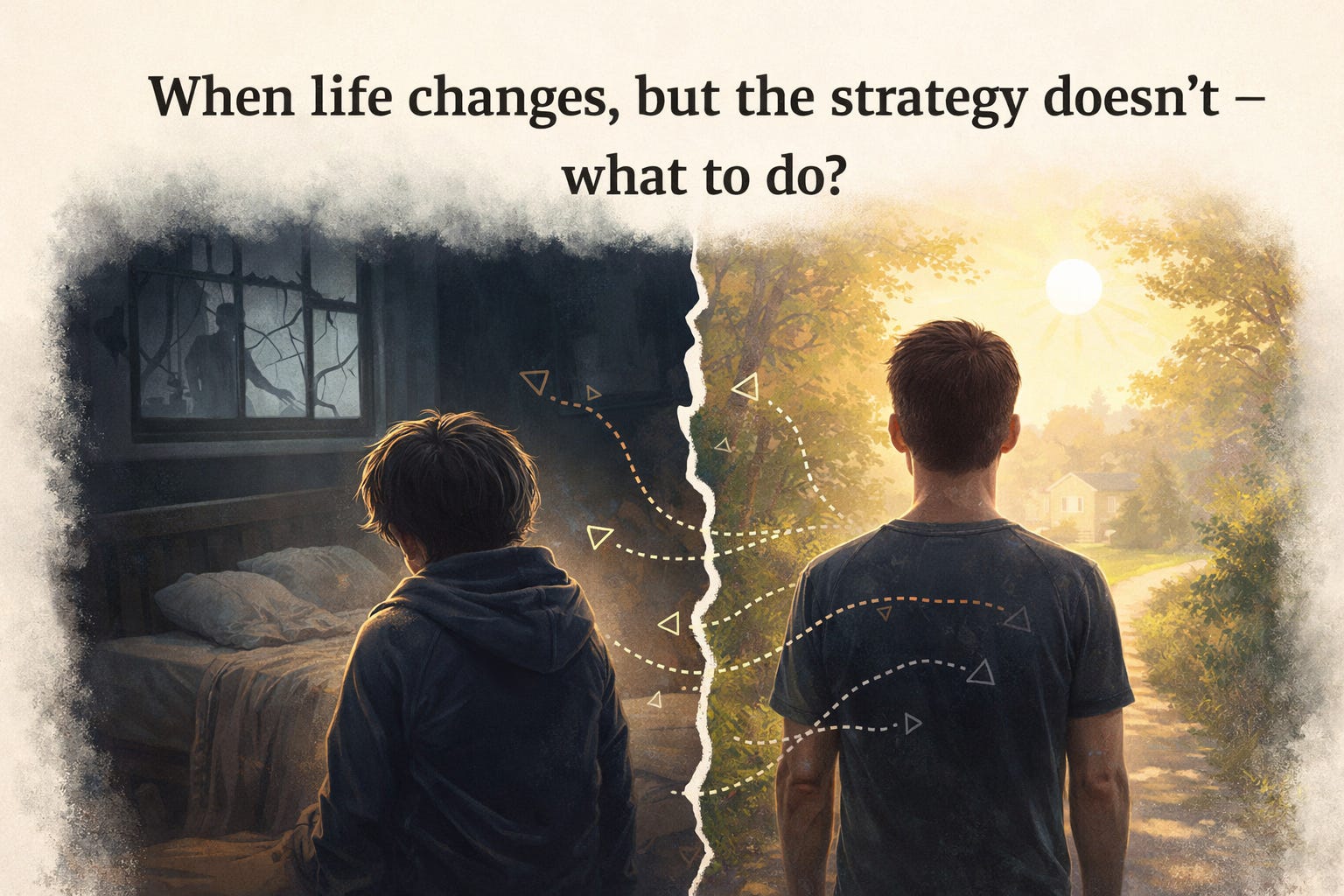
One of the hardest things for people to grasp emotionally – not intellectually – is that the problem is not that a strategy exists, but when and where it is still being used.
The nervous system does not operate with a calendar. It does not notice that ten years have passed, that the house is different now, that the people around you are no longer dangerous, or that you are no longer small. It operates through pattern recognition, asking one question, over and over again:
Does this situation resemble something that once required protection?
If the answer is even vaguely “yes,” the body responds accordingly. It has to.
This is why my clients so often say things like:
“I know I’m safe, but my body doesn’t.”
“I understand it rationally, but it doesn’t help.”
“I can see it’s not logical, yet I still freeze.”
That gap between cognitive insight and bodily response is simply how learning under threat works. Strategies that emerge under threat and trauma are encoded procedurally, that is, as automatic patterns of perception, sensation, and action. They are not stored as beliefs you can reason your way out of. That would ask the nervous system to be more rational than it was ever built to be. They are stored as readiness and preparedness. Just in case!
So, when someone asks me, “Why doesn’t my nervous system update automatically when my life improves?” I almost always answer: “Because it was never designed to.”
And here’s another one-liner I often hear myself saying: “Safety is learned through repeated, embodied experiences of approaching something new and surviving it. It is rarely proven by words (including those you say or think to yourself).
These strategies are not “choices” in the moral sense. But they do become places where we can practice a little more choice over time. The point of everything below is not to fight your defenses, but to build enough safety that your system no longer needs them in the same way.
When gratitude and grief collide
There is a characteristic emotional crossroads many people hit in therapy when they begin doing trauma work.
It is the moment where you can see, with absolute clarity, that a strategy saved you and it is now costing you something precious. By definition, this moment brings mixed emotions that feel contradictory.
Gratitude toward the part of you that found a way to survive; grief for the life that strategy now prevents you from living.
Compassion toward your younger self; anger that it was ever necessary.
Fear of letting go of something that once meant safety.
Many people try to rush through this moment. They want to “drop” the strategy as soon as they understand it and categorize it as a problem. That rarely works. You cannot evict a protector that still believes it has a job. You can only retire it by
