
There is no such thing as a “wrong” way to survive trauma. But what happens later?
- A response to Dr Jessica Taylor

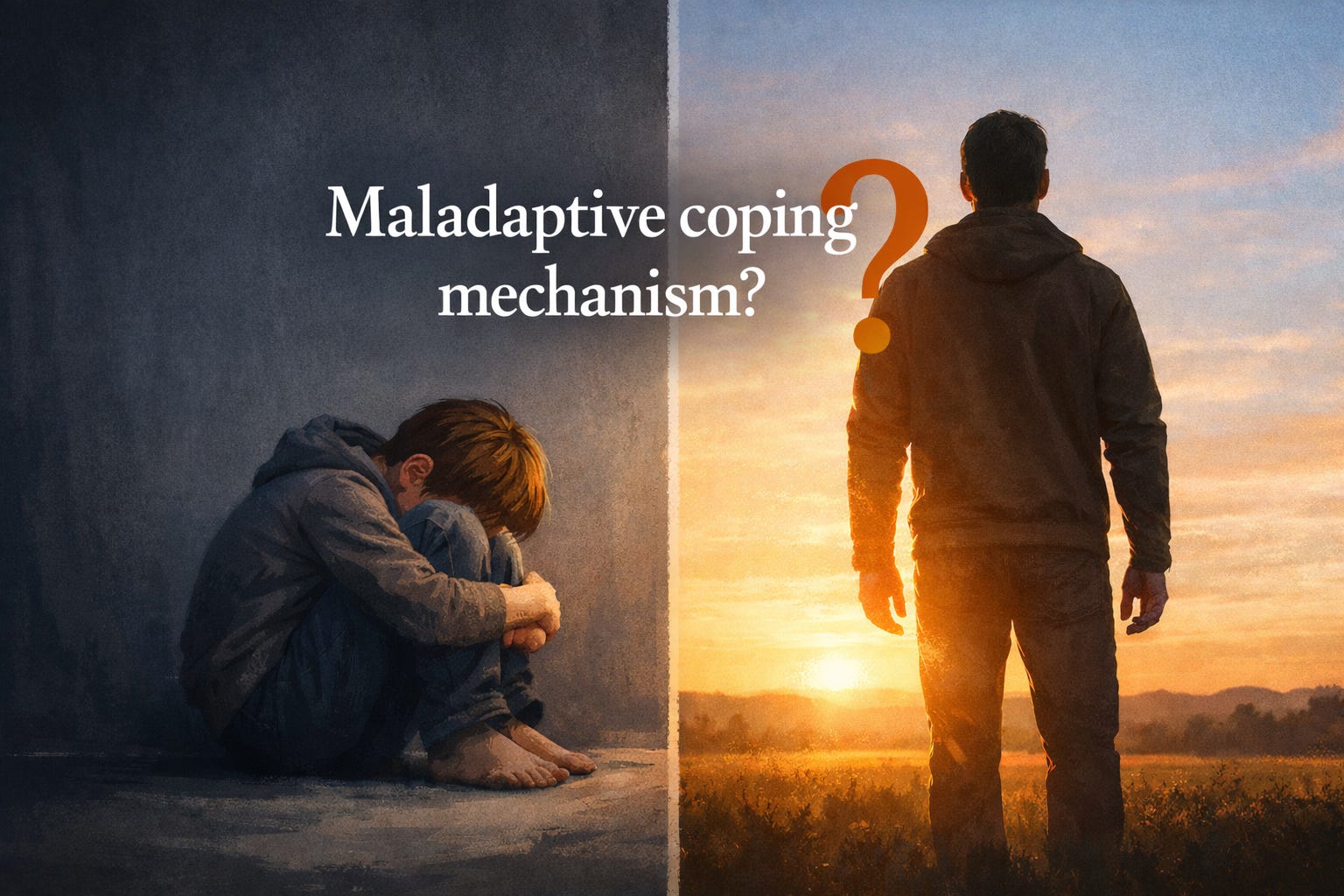
In a recent post, Dr Jessica Taylor called to “urgently, completely, and without apology” stop using the term maladaptive coping mechanism, arguing that the phrase misrepresents survival as defect and frames life-saving strategies as flaws.
First things first: I agree with Dr Jessica Taylor 100%.
There is no such thing as a maladaptive coping mechanism at the time it emerges.
Not one. Not in the lived experience of trauma, and certainly not in the nervous system of a child trying to survive the impossible.
To use her own words, calling a survival strategy “maladaptive” implies:
“that the ways you survived were wrong… that what kept you alive was, in itself, a kind of flaw.”
Exactly. And that implication is both incorrect and profoundly unfair – and frankly, what we in the trauma field are actively fighting to get away from, because it has derailed so many lives unnecessarily by pathologizing instead of understanding their suffering and their ways through it.
Nothing happens in a vacuum
People do not dissociate, drink, withdraw, worry, ruminate, appease, suppress, threat monitor, hear voices, overachieve, numb, self-harm – or engage in anything else psychiatry calls a “symptom” – in a vacuum. They do so because, at a particular moment in their life, it was the only possible response that maximised safety. The nervous system simply did its thing: it adapted intelligently and creatively, with a deeply embodied instinct for self-protection.
Nothing about that is maladaptive. In fact, it is adaptive by definition.
Every day, I am humbled by the wisdom and sheer intelligence of the coping strategies the clients who come to see me developed to keep themselves going in times of adversity. That’s why I categorically refuse to call them mental illnesses, because they make sense in context.
That’s what I mean when you hear me say that I’ve never seen a mental illness; never seen the behaviors and patterns not make sense in light of what happened; and hence, pathologizing words like “illness” or “disorder” do not make sense.
I agree entirely with Dr Taylor that we must stop punishing people for the very behaviors that carried them through hell. I am fully on board with leaving the word maladaptive behind.
And yet, this opens the question: what, then, do we call the coping mechanisms that later become problematic in our lives, if not maladaptive?
Where the word “maladaptive” comes from
In clinical psychology and emotion regulation research, when we talk about “maladaptive strategies,” we are not judging the origin of the strategy. Never. We are describing its current effect on a person’s life.
Persistent emotional suffering is often maintained by certain ways of responding to difficult emotions over time (certain emotion regulation strategies). In short: It’s not the emotion that is the problem; it’s that the distress persists.
And what makes distress persist is not the original trauma itself, but the strategies and patterns a person understandably learned in order to cope with that trauma, if those strategies and patterns later begin to backfire. Let’s name a few classics:
avoidance that once kept someone safe becomes isolation
hypervigilance that once prevented danger becomes chronic anxiety
emotional numbing that once protected the Self becomes disconnection
overthinking that once kept chaos predictable becomes a trap and a prison
alcohol that once soothed unbearable pain becomes dependence
“I know what I want, but I can’t go there”
These are the situations where we know what they want and need, but can’t go there. We want closeness, but our body pulls away. We value honesty, but our throat tightens when we try to speak. We long for rest but cannot stop staying busy. We want to move toward meaning, connection, creativity, purpose, or a self-defined goal, and yet something inside reacts as if that movement is dangerous.
The confusion is real. “I want to go over there in my life – but my nervous system reacts as if I’m stepping into threat.” It is an old protective system doing exactly what it once had to do, even though the context has changed. None of these responses were ever wrong. They were brilliant, necessary adaptations to danger.
Why he nervous system doesn’t automatically update
And because protection and survival take top priority in our system, readjusting to safety later in life is not automatic. In fact, it’s often exactly what doesn’t happen. The nervous system does not update itself simply because circumstances improve. It keeps inviting us (cus they are invitations, not commands) to use the strategies that once worked, even when those same strategies now work against the life the person wants to live.
This is what the clinical term maladaptive aims to capture. Not that the strategy was wrong at the time, but that it no longer regulates distress as intended and instead maintains or amplifies suffering over time.
Adaptive then. Maladaptive now. Same strategy. And so, the solution becomes part of the problem – but only later in life.
To quote myself from my recent book: “Our strategies can certainly be both perfectly comprehensible and maladaptive at the same time. Something can make perfect sense in its origin and still cause suffering years later. Something can be brilliant then and burdensome now. Something can be protective then and limiting now.”
Where Dr Taylor is absolutely right to push back
The problem – and I agree strongly with Dr Taylor here – is that the word maladaptive is so often, understandably, heard not as the technical description above but as a moral judgement.
“You coped wrong”, “You should have known better”, “You’re dysfunctional”, “It’s your own fault”.
The language does risk pathologising survival and turning strength into “symptom”, just as psychiatry’s “disorder,” “deficit,” mental illness,” and psychopathology” all do.
So, what should we call it?
If we want language that:
A) honours the original adaptive value
B) avoids moral judgement
C) avoids pathologising survival
D) but still acknowledges when a strategy turns into a problem that maintains suffering
E) and helps us talk about what keeps distress going over time
F) while also pointing toward change and healing, rather than implying that suffering is permanent… what should we call it?
I genuinely ask this with respect and curiosity. Because “maladaptive” carries baggage, but we still need a word for the moment when a once-protective strategy begins to limit a person’s ability to live the life they want now. Whatever we call it, the language should make it easier – not harder – for people to recognise themselves with compassion and move toward the lives they want to live.
How do we name that transition without shame, and without implying that survival was ever wrong?
If you’ve lived this transition yourself, how do you describe it? What language helps you make sense of it in your life?
And Dr Jess – I’d love to hear your thoughts :)!
True insight! Such intelligent psychologist is a blessing! I am reading Crossing Zero and the value of the content is immense.
For myself, I have learned to say, that strategy is what I learned and have been used to doing, but it isn't working for me anymore. I want to do something different. Or be different, or whatever.